
This meeting brought together researchers, partners, and stakeholders for in-depth discussions and networking as we explored collaborative opportunities to address current and emerging water challenges in New York.
Attendees included:

Location: Gateway Center Concourse
Details: A key component of the meeting is to provide an opportunity to share research, results, and make connections with potential partners for collaborations with academia and outside entities.
Location: Gateway Center Concourse
Location: Gateway Concourse and Center
Location: Gateway Center
Welcome from our Host Institutions
Welcome from the Center’s Co-Directors
A Survey of Climate and Adirondack Lake Ecosystems (SCALE)
Charles Driscoll
Professor, Syracuse University
The Adirondack region includes important water resources of New York State, with an abundance of wetlands, streams and lakes. These water resources are being impacted by a variety of drivers, including climate change, changes in air pollution, invasive species and salinization. SCALE, a Survey of Climate and Adirondack Lake Ecosystems, is being conducted to better understand and ultimately manage the effects of these drivers. An extensive survey will occur with detailed seasonal measurements for a subset of the survey lakes starting in 2026. SCALE has leveraged historical datasets to select focal lakes and set baselines. High-frequency sensors, eDNA, water chemistry, and remote sensing will be used to characterize these ecosystems from lake physics to fish. SCALE seeks to address diverse research questions, including: How has warming and extreme weather affected the environmental conditions (temperature, oxygen, nutrients, toxins) and biota of Adirondack lakes? How does climate change affect carbon transport, cycling, storage and function in lakes? Why are harmful algal blooms (HABs) becoming more prevalent? Our results will be shared with the scientific community to encourage additional research and collaboration and NYSDEC and the public to guide adaptive management.
SESSION 1A
Sensors and Remote Sensing: Emerging Techniques for Efficient, Data-dense Monitoring
Moderators:
Presenters:
Water quality monitoring is critical to sustainable management of aquatic resources, yet budgetary and personnel limitations often prohibit measurements that are adequately dense in time and space to meet monitoring objectives. Advances in in situ sensor and remote sensing technologies offer cost-effective data streams that can supplement existing monitoring programs to meet resource manager needs. This session will explore a) new sensor technologies that offer sensitive, selective, rapid, and portable detection of contaminants in water at low cost, b) emerging satellite remote sensing efforts for various water quality parameters, and c) ways in which the two can be linked for holistic, multi-scaled monitoring approaches. A series of short talks will showcase examples of such efforts, and a brief panel discussion will follow. Through examples and discussion, the session seeks to facilitate connections that enable scientists to understand monitoring priorities and resource managers to gain awareness of available methods.
SESSION 1B
Healthy Watershed Governance & Organizing Models: Ideas and Inspiration for Watershed Across NYS
Moderators:
Presenters:
How are communities across New York State organizing to protect and restore their watersheds — and what can we build? This panel brings together practitioners from watersheds across NYS to share governance structures, partnership models, and organizing strategies driving real progress on water quality, resilience, and stewardship. Panelists will share concrete actions they have taken from policy to public art along with how their organizations are structured, who they partner with, and what they’ve learned along the way. The panel will be followed by a facilitated discussion focused on applying these models closer to home: What structures or initiatives could take root in your watershed and specifically here in the Onondaga Creek Watershed? This session is designed for anyone working in or caring about watersheds across New York who wants to learn from peers and help shape a vision for stronger, more coordinated watershed stewardship.
Location: Gateway Center
SESSION 2A
Controlling Nutrients – Improving NYS Water Quality
Moderator
Presenters:
Wastewater, whether from large community-sized treatment plants or small home or non-community-sized septic systems, can negatively impact New York’s waters by discharging nutrients like nitrogen and phosphorus into the environment. These nutrients can cause water quality problems, including eutrophication and harmful algal blooms, which threaten human health and the state’s economy by impairing recreational opportunities, diminishing property values and increasing the cost for potable water treatment in the downstream watersheds. The State of New York is taking action to address this challenge by adopting regulations and providing funding for improvements. While these regulations and state-level oversight are easy to implement at large community-sized wastewater treatment facilities, on-site septic systems are regulated at a local level, constitute hundreds to thousands of installations in each community and are therefore more difficult to monitor and control. Still, programmatic success can be achieved. To explore this topic, this session will include three short talks that demonstrate programmatic and technological success stories when implemented in communities in NY (and across the country) that have decentralized wastewater treatment and increasing nutrient derived water quality problems have been recognized.
SESSION 2B
Field Deployment of Integrated Foam Fractionation and Supercritical Water Oxidation for PFAS Treatment in Landfill Leachate
Moderator:
Presenters:
Landfill operators are facing increasing regulatory and operational pressure to manage per- and polyfluoroalkyl substances (PFAS) in leachate as discharge limits tighten and long-term liability concerns intensify. Conventional treatment approaches often struggle with dilute and highly variable leachate compositions, resulting in high operating costs and residual PFAS waste streams.
This presentation describes a full-scale field demonstration of an integrated treatment strategy combining foam fractionation (FF) for PFAS separation with Supercritical Water Oxidation (SCWO) for final destruction. Foam fractionation selectively concentrates PFAS from landfill leachate without the use of chemical additives, producing a significantly reduced-volume foamate stream suitable for downstream destruction.
Revive Environmental deployed this FF system at a major U.S. landfill treating leachate impacted by PFOS and PFOA. The system consistently reduced PFAS concentrations in the treated effluent while operating under variable flow and influent conditions typical of landfill operations. Concentrated foamate generated by the FF process was transported offsite to Revive’s permitted SCWO facility, where PFAS compounds were mineralized. Post-treatment results were verified by an accredited analytical laboratory, with treated effluent achieving concentrations consistent with current U.S. EPA drinking water standards prior to permitted discharge.
The case study demonstrates that an integrated FF+SCWO approach provides a scalable, commercially available solution for managing PFAS-impacted landfill leachate. Benefits include reduced treatment volumes, lower lifecycle costs, regulatory compliance readiness, and elimination of long-term PFAS disposal liabilities. The findings are applicable to a broad range of industrial and municipal leachate and wastewater streams facing emerging PFAS regulations.
SESSION 3A
Water Interests in New York’s Growing Semiconductor Industry
Moderator:
Presenters:
Semiconductor industries require significant resources for their operation. Ultra-pure water is used for manufacturing, wastewater from the process may contain constituents that must be managed accordingly to avoid negative environmental impacts. The session will provide an overview of some potential contaminants of interest in the generated waste stream, a testing protocol that will determine potential inhibition of biological wastewater treatment and treatment technologies that remove trace contaminants.
SESSSION 3B
Preparing the Next Generation for Professional Pathways in Water: Approaches, Partnerships, and Lessons Learned
Moderators:
Presenters:
Protecting water resources and sustaining the workforce that cares for those resources require close collaboration across disciplines, institutions, and communities, often in tandem with changing industry needs. This session brings together lessons from community-engaged water quality monitoring and student internship programs to explore how inclusive partnerships can strengthen both aquatic resource stewardship and workforce development in New York State. Drawing on case studies from SUNY ESF’s SHARCS (Sampling for Healthy Aquatic Resources with Community Science) program, and utility-based student internship programs through Syracuse University’s Institute for Sustainability Engagement, which houses the only EPA-designated Environmental Finance Center in New York. The speakers will highlight how interdisciplinary research, community science, and hands-on learning can expand data collection, elevate local knowledge, and build stronger pathways into water careers. Through brief presentations and a facilitated discussion, attendees will examine challenges, best practices, and strategies for integrating academic research, community participation, and workforce pipelines to support resilient water systems and the next generation of water professionals.
Location: Gateway Concourse
Location: Gateway Center
Courtney Johnson-Woods, Business Development Manager, NYS Center of Excellence in Healthy Water Solutions at Clarkson University and SUNY ESF
SESSION 4A
Research Planning and Insights in SCALE: a Survey of Climate and Adirondack Lake Ecosystems
Moderators:
Workshop Leaders:
This session will begin with an overview of SCALE, a Survey of Climate and Adirondack Lake Ecosystems. The overview will cover the lakes being studied, the measurements being made, and the research motivations. Audience members will then be asked to break out into working groups to discuss several topics. The topics will be a mixture of pre-defined topics and those solicited from workshop participants. Working groups will then discuss potential research questions and how data can be used. Working group report backs will enable all workshop attendees to hear what other groups were discussing. If time permits, there may be more than one round of working group break out sessions to enable people to participate in discussions on multiple topics.
SESSION 4B
VersaWater: Addressing Small Water System Challenges in New York State – A Collaborative Learning Session
Moderator:
Presenters:
New York’s small public water systems face mounting challenges: escalating construction costs, limited federal funding access, diseconomies of scale, and increasingly turbid source waters from more frequent storms. VersaWater—a collaboration of researchers and practitioners from Syracuse University, Cornell University, InterAmerican University of Puerto Rico, and Agua Clara Reach, an NY-based non-profit—offers a community-centered approach using electricity-free, prefabricated water treatment plants that reliably treat turbid waters at lower cost through gravity power alone, combined with comprehensive support for federal funding access, regulatory compliance, and operator training. The VersaWater Initiative was selected for competitive phase 2 funding from the National Science Foundation’s Convergence Accelerator under its Future Water Systems Track.
This session brings together VersaWater collaborators to share experiences from piloting this “”utility-in-a-box”” model. Through short presentations, team members will discuss implementation challenges encountered, lessons learned about community engagement, regulatory navigation, and technical adaptation in both New York and Puerto Rico contexts and engage attendees in discussion around challenges, needs, and ways to collaborate more broadly with New York’s water sector and community.
The session will center discussion around key questions: How can we better support small systems in accessing and sustaining safe drinking water? What NYS-specific regulatory, financial, and technical challenges require collaborative solutions? How can research, practice, and community knowledge converge more effectively? Participants will engage in problem-solving dialogue about advancing this model’s applicability across New York’s diverse small water systems, contributing to more equitable and resilient water infrastructure statewide.
Location: Gateway Center
Thank you for attending! Don’t forget to recycle your name badge at the registration table on your way out.
A key component of our annual meeting is to provide an opportunity for faculty and student researchers, agencies, non-profits, industry, associations, anyone interested in the mission of the Center to share research, results, and make connections with potential partners in academia and outside entities.
Poster topics are water related, New York State relevant, and linked to at least one of the the following general areas:
The Annual Meeting Poster Sessions and Receptions are generously supported by
NEW THIS YEAR
To jump start interactions during the in-person poster sessions, the CoE will be requesting accepted poster presenters to pre-record and submit lightning talks in advance of the meeting so that attendees can view them before arrival and start planning their paths for engagement. Guidelines and instructions for this new poster presentation requirement will be provided to those selected.
View Lightning Talks here: https://bit.ly/2026-Playlist
If your firm or organization is interested in sponsoring the poster sessions, please email coe@healthywaters.org for the prospectus.
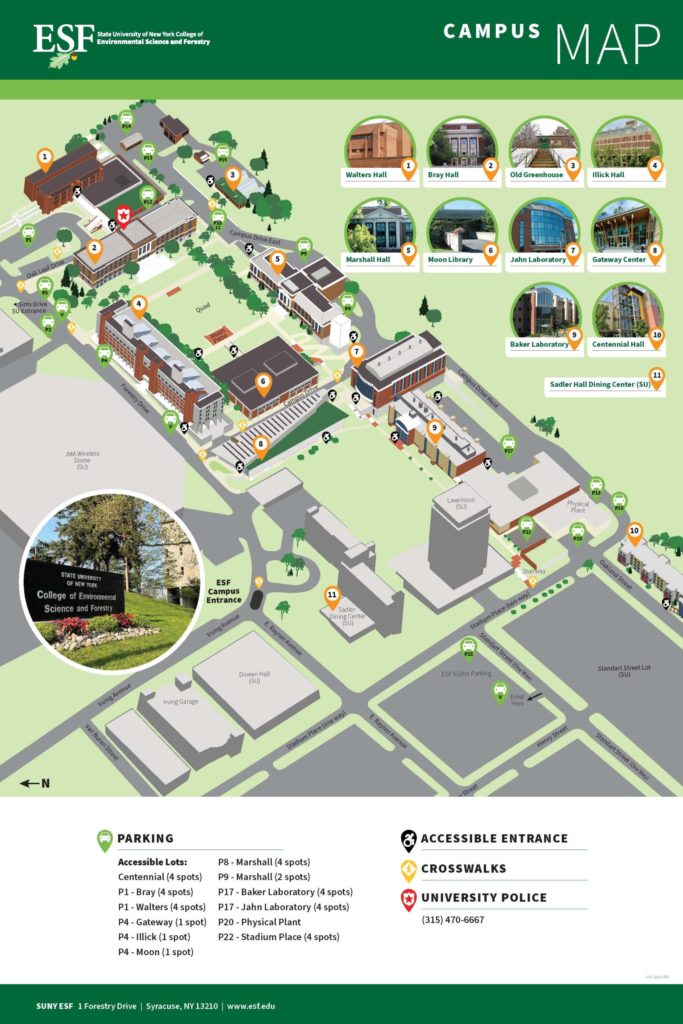
https://www.esf.edu/about/maps/index.php
Using an App or GPS?
Campus entrance address: 1000 Irving Ave., Syracuse, NY
Check-in and main meeting sessions take place in the Gateway Center (building 8 on the campus map).
From I-90:
From I-81
Sustainable Transportation Methods
Keep in mind ESF’s institutional goals focus on a more sustainable future. Please consider some alternative ways to get to campus. Centro offers a network of services in the CNY area and has a Transit Hub located in downtown Syracuse. Visit their website for the most up-to-date schedules and maps. You can also learn about connecting services to Amtrak, Greyhound, MegaBus and Trailways. Additionally, to move around the Syracuse community there is an electric bike and scooter share program called Veo.
Accessibility
Visitors in need of accessible parking facilities should contact the CoE for assistance in arrangements in advance, or ESF University Police if on campus by calling (315) 470-4996.
No permit is required for attendees to park in these lots:
Attendees should fill up Lot P22 first.
Overflow parking available in the Standart Street Lot.
Lot P22 and Standart Street Lot are shown in the bottom right area of the campus map. Standart Street is a ONE-WAY road, so you may need to circle back around the block to get to the Standart Lot entrance if Lot P22 is full.
Visitors in need of accessible parking facilities should contact the CoE for assistance in arrangements in advance, or ESF University Police if on campus by calling (315) 470-4996.
Attendees are encouraged to make their hotel reservations early as space may fill up quickly in the area.
Best Western Syracuse Downtown Hotel & Suites
416 South Clinton Street, Syracuse, New York 13202
Additional hotels in the area can be found here and include:
Marriott Syracuse Downtown
100 East Onondaga Street, Syracuse, NY 13202
marriotthotels.com/syrmc
Collegian Hotel & Suites Syracuse
1060 East Genesee STreet, Syracuse, NY 13210
scholarhotels.com/scholar-hotel-syracuse